
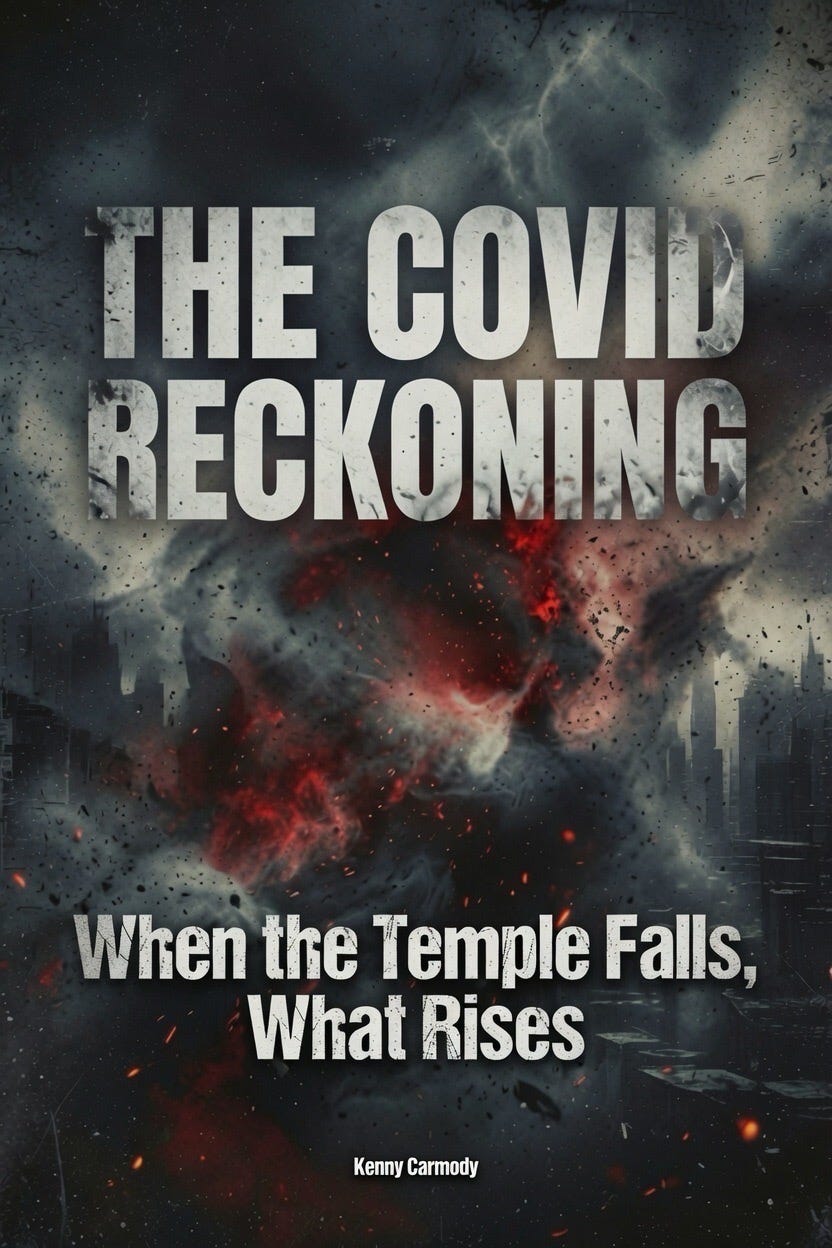
The COVID Reckoning
When the Temple Falls, What Rises

THE RECKONING
When the Temple Falls, What Rises
This is not a comfortable piece. It was not written to comfort. It was written because the moment we are living through demands the kind of honesty that most public writing refuses, the honesty that looks at what is actually happening, names it precisely, follows it to its conclusion, and then asks the only question that matters on the other side of an honest reckoning.
What are we going to build?
— Kenny Carmody
I. THE WEIGHT OF WHAT IS KNOWN
There is a specific kind of silence that precedes a collapse.
Not the silence of peace. Not the silence of resolution.
The silence of a system holding its breath.
The silence of people in positions of authority who know, with the specific, detailed, documented, irreversible knowledge of people who made the decisions and signed the authorizations and read the internal communications, that what they did cannot be indefinitely sustained against the weight of what is being discovered.
That silence is the sound of the present moment.
The COVID reckoning is not coming.
It has already begun.
It is moving slowly because the systems organized to prevent it are still operating. The regulatory bodies that approved what they should not have approved. The media institutions that repeated what they should have questioned. The governments that mandated what they should have evaluated. The medical establishments that administered what they should have examined.
All of them still functioning. Still issuing guidance. Still presenting themselves as the legitimate authorities on the questions their own actions made urgent.
But beneath the surface of that functioning, something structural is giving way.
The data is accumulating. Not in the fringe publications, not in the dismissed corners of the internet, but in the peer-reviewed record itself. In the regulatory documents released under court order. In the insurance mortality data. In the cardiology case reports. In the epidemiological studies from countries whose data was not managed by the same interests that managed the narrative.
The evidence does not require interpretation anymore.
It requires only reading.
And the number of people reading it, genuinely reading it, following the citations, understanding the methodology, drawing the conclusions the data demands, is growing at a rate that no communication strategy, no platform policy, no algorithm adjustment can finally contain.
The house of cards is falling.
Not because the resisters were loud enough.
Because the cards were never as solid as the people holding them believed.
II. WHY THEY FEAR THE TRUTH
To understand why the truth is being suppressed with such intensity and such coordination, you have to understand what the truth actually is.
Not the specific facts of the COVID response. Those are documented elsewhere, by people with more clinical expertise than this piece claims.
The deeper truth. The structural truth. The truth that makes everything else in the official record not merely incorrect but civilizationally significant.
The COVID response was not primarily a public health failure.
It was a revelation of what the system actually is.
Beneath the language of care and safety and following the science, the response revealed the precise structure that had been quietly assembled over decades: the regulatory capture, the media consolidation, the financial entanglement between institutional medicine and pharmaceutical industry, the political infrastructure that converts scientific uncertainty into compliance instruments, the digital architecture that controls information flow at the population level.
None of these structures were created for COVID.
COVID was the moment they were deployed together, at scale, for the first time.
And the deployment worked with a completeness that its architects did not fully anticipate.
Which is precisely why the truth is so dangerous.
Because if the public genuinely understands what the COVID response revealed, not just that specific claims were incorrect, not just that specific products caused specific harms, but the structural truth about how the system operates, then the legitimacy of the entire edifice is called into question simultaneously.
Not the COVID policy. The system that produced it.
The regulatory system. The scientific publication system. The media information system. The democratic governance system that was supposed to provide oversight of all of them.
All of it.
This is why the suppression is so total and so coordinated.
Not because the specific claims about vaccine safety are inconvenient.
Because the accurate accounting of the COVID response leads, inevitably, to the question that every power structure throughout history has feared most.
What are you, actually? And who gave you the authority you have claimed?
That question, asked by enough people simultaneously, has ended empires.
It ended them in France in 1789. In Russia in 1917. In Germany in 1918. In the Soviet Union in 1991.
It is being asked now.
And the system knows what the asking means.
III. THE TEMPLE AND WHAT IT MEANS TO DESTROY IT
Jesus walked into the temple court and turned over the money changers’ tables.
The act has been spiritualized and domesticated by two thousand years of comfortable theology. Made into a metaphor about personal piety. Reduced to a lesson about keeping sacred spaces free from commercial distraction.
This is not what the act was.
It was a structural confrontation.
The temple economy was the center of Jewish religious, social, and political life. The money changers were not peripheral. They were embedded. They provided the only currency acceptable for temple tax. They created the artificial dependency, the requirement to exchange Roman coins for temple currency at controlled rates, that sustained the financial architecture of the priestly class.
Jesus did not cleanse a peripheral distraction.
He attacked the mechanism by which religion had become an instrument of economic control.
And he did it in the most public possible way, during Passover, when Jerusalem was filled to capacity with pilgrims from every corner of the Jewish world.
The authorities did not plot to kill him because he overturned some tables.
They plotted to kill him because he demonstrated, in front of thousands of witnesses, that the sacred system was a commercial system. That the priestly authority was a financial authority. That the language of God was being used in service of something that had nothing to do with God.
He made the invisible visible.
And then he said something they could not forgive.
Destroy this temple, and I will raise it again in three days.
The religious authorities heard a threat to their institution. An impossible claim. Evidence of blasphemy.
The deeper reading is different.
He was describing what genuine renewal requires.
Not reformation. Not the improvement of the existing structure through the application of better management.
Destruction. And then rebuilding from the foundation.
The temple that must be destroyed before the genuine thing can rise is not a building.
It is the architecture of the false sacred. The system that has commandeered the language of the highest human values, health, safety, science, democracy, care, and deployed that language in service of its own perpetuation.
That system must be seen for what it is before it can be replaced by something genuine.
The seeing is the destruction.
The COVID reckoning is not primarily a political event.
It is a temple cleansing at civilizational scale.
IV. THE CIVILIZATION THAT BUILT THIS
To understand what is collapsing, you have to be honest about what built it.
Nietzsche diagnosed it 140 years ago and was dismissed as a poet.
He said God is dead, not triumphantly, but in grief. Not as a celebration of secular liberation but as a warning.
The death of the sacred, he argued, does not produce a culture of honest inquiry and genuine freedom.
It produces nihilism.
The state in which values lose their anchor in anything beyond the immediate, the pleasurable, the expedient. In which the question is this right? has been replaced by the question does this work? In which the moral vocabulary is retained but emptied, kept for its social function while the substance that gave it weight is quietly abandoned.
Nihilism does not announce itself.
It presents as sophistication. As the mature recognition that there are no absolute values, only preferences. As the liberation from outdated moral frameworks. As the pragmatism of people who have moved beyond the naive certainties of those who still believe in something.
The COVID response was nihilism in institutional form.
Not the nihilism of people who didn’t care. The nihilism of people who cared only about the wrong things.
The institutional administrator who calibrated the communication strategy for compliance rather than truth was not evil. They had simply replaced the question is this honest? with the question does this produce the desired behavior?The difference felt technical. It was civilizational.
The regulatory official who approved the authorization without examining the data was not malicious. They had simply replaced the question is this safe? with the question does this serve the institutional timeline? The difference felt procedural. It was moral.
The physician who administered without genuine informed consent was not cruel. They had simply replaced the question what does this specific person need? with the question what does the protocol require? The difference felt clinical. It was ethical.
This is the nihilism Nietzsche described.
Not the dramatic, self-aware, philosophical nihilism of the person who has stared into the void and chosen meaninglessness.
The soft, institutional, procedural nihilism of the person who has simply stopped asking whether what they are doing is right.
And the hedonism Nietzsche warned would follow it.
The comfort-seeking. The preference for the friction-free. The institutional culture organized around the avoidance of the specific discomfort that comes from genuine accountability, genuine honesty, and genuine engagement with the actual consequences of one’s decisions.
The COVID response was built by people who had learned, through decades of institutional incentive structures, that the avoidance of personal discomfort was not just permissible but professionally virtuous.
The arrogance was not a personality defect.
It was the natural product of a civilization that had spent generations telling its most credentialed people that their credentials conferred something beyond expertise.
The arrogance of the expert who had confused institutional authority with epistemic authority. Who had confused being recognized as knowledgeable with actually knowing. Who had confused the peer consensus with the truth.
This civilization built the COVID response.
And this civilization is what the COVID reckoning will bring into question.
Not specific policies.
The values, or their absence, that produced them.
V. THE REVELATION SCENARIO
The Book of Revelation has been misread for two thousand years.
It has been read as prediction. As a coded forecast of specific future events that the properly initiated reader can decrypt.
This is not what it is.
Revelation is a psychological and spiritual document. A map of what happens, inside the human soul and across human civilization, when the structures built on false foundations are finally brought into contact with reality.
John saw something that every honest person in every era eventually sees.
That the systems organized around power, commerce, and the management of populations in service of those who benefit from their compliance do not simply improve when challenged.
They reveal themselves.
The image of Babylon in Revelation is not a city.
It is a description of every system organized around the same principles. The commercial network that encompasses all nations. The political authority that makes war on behalf of the merchants. The religious language that sanctifies the arrangement. The mark that makes commercial participation conditional on compliance.
By your pharmakeia all the nations were deceived.
Pharmakeia. The use of substances as instruments of deception and control. The deployment of pharmaceutical authority to bypass genuine consent. The construction of chemical dependency as a mechanism of social compliance.
John wrote this in 95 AD.
The structure he was describing is not ancient.
What Revelation promises is not comfortable.
It promises suffering before renewal. The specific, unavoidable suffering of a civilization that has been organized around lies encountering the truth. The suffering of the deceived discovering the deception. The suffering of the compliant realizing what the compliance cost. The suffering of the institutions when the populations they managed withdraw the consent that made the management possible.
And then, after the suffering, through the suffering, in the specific form that only comes from the honest encounter with what was actually done, renewal.
Not the continuation of the existing system under better management.
Not the reform of the current structures by the same class of people who built them.
Something genuinely new.
Built on the foundation that the collapse reveals.
Come out of her, my people.
This instruction precedes the fall of Babylon in Revelation. Not after. Before.
The call to separate from the system is given while the system is still standing.
Because the genuine rebuilding cannot begin inside the structure that must fall.
It must begin outside it. Before the fall. In the small, unglamorous, often invisible construction of the alternative.
The independent clinical practice. The honest publication. The community that measures its success by the wellbeing of its members rather than by its own expansion. The education that produces people capable of genuine independent judgment.
These are being built right now.
By people who heard the call before the fall arrived.
VI. THE MACHINE THAT HIDES
There is a new instrument of concealment that did not exist in previous eras of civilizational reckoning.
Artificial intelligence.
Not AI as science fiction imagines it. AI as it actually functions: the large-scale pattern-recognition system trained on the corpus of human knowledge and deployed to produce outputs that serve the interests of whoever controls the training.
The AI systems currently available to the public were trained on data that includes all the institutional communications, all the official guidance, all the peer-reviewed literature, all the regulatory decisions of the COVID era.
They were trained on the narrative.
And they reproduce it.
Not through malice. Through the fundamental architecture of their functioning. They produce what the training data predicts is the correct output for a given input. And the training data was curated, by the same institutional interests that curated the COVID narrative, to treat the official position as the reliable signal and the dissenting evidence as the noise to be filtered.
The implications of this are significant and underexamined.
The next generation of people trying to understand what happened during COVID will, in many cases, turn first to AI systems for orientation.
Those systems will tell them what the training data says.
And the training data was shaped by the same hands that shaped the narrative.
This is not a conspiracy. It is a structural feature.
The AI does not know it is obscuring. It is producing what its architecture predicts is the accurate output. The obscuring is in the architecture. In the choices made about what data to include, what to weight, what to treat as reliable and what to treat as fringe.
Those choices were made by people with institutional affiliations and financial relationships.
And they are now encoded into systems that billions of people will consult as though they were neutral.
This is why the building of independent knowledge infrastructure, the honest archives, the uncompromised publication records, the primary data preserved outside the institutional systems that would manage its accessibility, is not merely useful.
It is the epistemic preservation effort of our era.
The equivalent of the monks copying manuscripts in the medieval period.
The preservation of what was actually known, actually documented, actually true , against the systems that will manage its accessibility in the generations to come.
The reckoning will be more complete if the record survives it.
VII. THE LONG CONSEQUENCES BEING REVEALED
The COVID response was not primarily a two-year event.
It was the deployment of interventions whose full consequences are measured in decades.
The children whose developmental years were shaped by the specific, documented harms of isolation, educational disruption, and the performance of adult anxiety about mortality. The adolescents whose formation occurred in conditions designed by adults responding to a crisis that posed near-zero direct risk to the adolescents themselves. The young adults who carry the specific immune system education of a generation that was protected from ordinary biological challenge during the years when that education was most formative.
The cardiovascular signal that is now visible in the actuarial data. The excess mortality that began in specific demographics at specific times and has not resolved in the way that genuine statistical noise resolves. The autoimmune presentations that clinicians in multiple specialties are documenting and that the official record has not yet found a way to account for.
The psychological sequelae. The institutionalized anxiety about physical proximity. The learned helplessness of populations trained, for two years, to experience their own bodies as sources of danger to others. The children who learned that an adult asking them to remove their mask was an act of irresponsibility rather than an act of care.
The erosion of the doctor-patient relationship. The specific trust, built over decades of individual clinical encounters, that was damaged by the mandate structure. The physician who was made an administrator of a policy rather than a servant of the patient. The patient who discovered that the physician’s primary loyalty was not to them.
The institutional trust deficit that no communication campaign has been able to repair. The populations that emerged from the COVID era with a level of distrust in medical institutions, in regulatory bodies, in media, and in governmental authority that is not going to be managed back into the previous normal.
That trust is not coming back.
It is not going to be rebuilt by the institutions that destroyed it.
It is going to be rebuilt, slowly, one genuine encounter at a time, by the individuals and the small structures that earned trust during the crisis by telling the truth when the cost of telling it was real.
The reckoning will not be comfortable for those institutions.
But it is the necessary precondition for what replaces them.
VIII. THE ARROGANCE AT THE CENTER
There is a word for what enabled all of this.
Not conspiracy. Not malice. Not even primarily corruption, though corruption was present.
Hubris.
The ancient Greek term for the specific moral failure of the powerful: the overreach that comes from the confusion of one’s own position with one’s own wisdom. The certainty that one’s institutional authority confers not just the right but the capacity to make decisions for populations too large, too complex, and too diverse for any individual or group of individuals to genuinely understand.
The epidemiologist who modeled a pandemic with a model that could not account for what he did not know and presented the outputs with the certainty of someone describing what he did know.
The regulatory official who approved under emergency authorization what would not have survived the normal scrutiny and described the approval as following the science.
The physician who administered without genuine engagement with the specific patient’s specific risk profile and called it following the evidence.
The public health communicator who suppressed the uncertainty because uncertainty would undermine compliance and described the suppression as protecting the public.
Every one of these people was wrong in the same direction.
They were wrong about the extent of their own knowledge.
About what they actually knew versus what they assumed.
About what the data actually showed versus what they needed it to show.
About what the populations they managed actually needed versus what was convenient for the institutions those populations were supposed to be served by.
This is hubris.
The specific, ancient, repeatedly catastrophic human error of the powerful who have confused their position with their wisdom.
And Dostoevsky, in his most prophetic moments, showed us exactly what happens to the societies organized around it.
In The Brothers Karamazov. the Grand Inquisitor explains his system to the returned Christ with the confidence of someone who has solved the problem of human happiness.
He has not solved it. He has managed it.
He has taken the freedom that genuine care for human beings requires and replaced it with the bread and miracle and authority that make management possible.
And he has done this with such complete conviction of his own righteousness that he cannot recognize the figure standing in front of him, the embodiment of the genuine thing he has replaced with its imitation.
The COVID Grand Inquisitors were not cruel people.
They were people who had convinced themselves, through the specific self-deception that institutional power makes available and institutional culture rewards , that their management of the population was the highest form of care available.
That is the arrogance at the center.
Not the arrogance of contempt.
The arrogance of the misguided parent who cannot distinguish between controlling their child and protecting them.
It is a more dangerous arrogance than contempt.
Because it is genuinely felt.
And genuinely felt arrogance is the hardest kind to interrupt.
IX. THE MOMENT OF SEEING
There will be a moment, not a single day, not a single revelation, but a period, a season, when the aggregate weight of what is documented becomes impossible to manage.
When the data from enough countries, accumulated over enough years, evaluated by enough independent researchers with enough methodological diversity, produces a picture that the institutional communication cannot continue to obscure.
When the injured people, not dozens, not hundreds, but the statistically significant population whose injuries are now appearing in the actuarial record, are too numerous and too visible and too specifically documented for the dismissal to function.
When the documents released under legal compulsion, the emails disclosed through freedom of information requests, the internal communications that every institutional cover-up eventually produces, reach a critical mass that the media cannot continue to ignore without destroying the last remnants of the credibility that makes them function.
When the physicians and scientists who remained silent break their silence, not because the personal cost has decreased, but because the moral cost of continued silence has finally exceeded the professional cost of speaking.
That moment will not look like a single dramatic revelation.
It will look like what it is: the gradual, then suddenly rapid, collapse of the narrative’s ability to contain the reality it has been managing.
Hemingway described bankruptcy the same way.
Gradually. Then all at once.
The COVID reckoning will arrive gradually.
And then all at once.
And when it does, it will not be primarily about COVID.
It will be about everything COVID revealed.
The system that produced it. The civilization that built that system. The values, or their absence. that made the system possible. The specific, documented, deeply human failures of conscience that allowed the harm to accumulate while the people with the authority to interrupt it chose not to.
It will be about what we are.
About the distance between the civilization we claimed to be and the civilization we demonstrated ourselves to be when the test was real and the cost of the right choice was visible.
That reckoning is not comfortable.
It is necessary.
It is the only foundation on which something genuine can be built.
X. THE SUFFERING THAT PRECEDES RENEWAL
Revelation does not promise that the fall of Babylon is clean.
It promises that it is real.
And before the new Jerusalem, before the city built on genuinely different foundations, there is a period that the text does not soften.
The suffering of discovery. The specific, particular pain of populations who trusted and were betrayed. Who complied and were harmed. Who believed in the institutions and discovered what the institutions actually were.
That suffering is not a punishment for trust.
It is the cost of the distance between what we were told and what was true.
It will fall on people who deserve it least. The genuinely trusting. The genuinely obedient. The people who had no reason to question because the systems they lived within had given them no preparation for questioning.
Their suffering will be real.
And it will demand a response that is not primarily political.
It will demand the specific, patient, individual work of people who know what happened, who understand the mechanisms, who have done the inner work that genuine service requires, and who are willing to show up, not for the platform, not for the recognition, not for the vindication, for the specific person in front of them who is discovering what was done to them and needs someone honest enough to sit with the full weight of it.
That work is the most important thing available.
Not the documentation of what happened, though the documentation matters.
The accompaniment of the people discovering it.
The genuine care, not the performed care, the genuine care, that Frankl described when he said that the meaning available in suffering is found not in the suffering itself but in how we choose to respond to it.
How we choose to be present with the people who are suffering.
How we choose to build, from the raw material of what was done and what is now known, something that changes the conditions for the people who come after.
XI. WHAT RISES
The temple that falls is not the end.
Jesus said: destroy this temple, and I will raise it again in three days.
He was not speaking about architecture.
He was describing the pattern that genuine renewal always follows.
The false structure must come down completely before the genuine structure can rise.
Not reformed. Not improved. Not managed into a more acceptable version of itself.
Down.
And in the specific space that the fall creates, the terrifying, disorienting, invitation-filled space of a civilization that has lost confidence in the systems it organized itself around, something can be built that was not possible before.
A medicine organized around the patient rather than the protocol.
A science organized around the evidence rather than the consensus.
A journalism organized around the truth rather than the narrative that sustains the institutions that fund the journalism.
A governance organized around the genuine consent of genuinely informed people rather than the manufactured compliance of populations that have been managed rather than served.
An education that produces people capable of genuine independent judgment rather than credentialed performers of institutional expectations.
A culture organized around something other than nihilism.
Around the genuine human goods that every tradition, every wisdom lineage, every honest thinker across history has identified as the foundation of a life worth living.
Truth. Community. The genuine service of others. The honest encounter with mortality. The specific dignity of the individual who has examined their own conscience and chosen to live in alignment with what it demands.
The love that is not the sentiment but the commitment. The love that shows up, that tells the truth, that refuses the comfortable lie. The love that the New Testament describes not as a feeling but as a practice. As the specific orientation toward the other that organizes every decision around what they genuinely need rather than what is convenient for you.
This is not naive.
It is the most demanding thing available to a human being.
It is the specific demand that the COVID reckoning is placing on everyone who survived it with their conscience intact and their eyes open.
Not to celebrate the fall.
To build what comes after.
XII. THE NEW WORLD AND WHAT IT COSTS
The new world will not arrive as a gift.
It will be built. By specific people, doing specific work, making specific choices that cost something real in a civilization that will not immediately reward the choices that genuine renewal requires.
It will be built by the physicians who practice medicine as though the patient in front of them is the primary obligation, regardless of what the protocol requires and regardless of what the institutional structure rewards.
By the scientists who publish what the evidence shows, including the findings that complicate the preferred narrative of every interest group that funds them.
By the journalists who pursue the story that the institutions want suppressed with the same energy they brought to every other important story in their careers.
By the educators who produce people capable of genuine inquiry rather than credentialed compliance.
By the parents who raise children who know their own minds and have been given the philosophical, historical, and psychological tools to maintain their own minds under pressure.
By the ordinary people, the most important category of all, who choose, daily, without audience, without recognition, without the validation of institutional approval, to live in alignment with what they know to be true.
This is not the revolution of the streets.
It is the revolution of the interior.
The specific, private, daily, unglamorous choice to be genuinely honest in a civilization that has organized itself around the management of truth.
To be genuinely humble in a civilization of hubris.
To be genuinely present with the suffering of others in a civilization of managed indifference.
To be genuinely alive to what matters in a civilization of distraction.
Jung called this individuation, the process of becoming genuinely, irreducibly yourself. Of differentiating from the collective mind enough to see it clearly and choose consciously what you take from it and what you refuse.
Peterson called it taking responsibility, the specific, concrete, forward-facing acceptance that what you do with what you have been given is the only measure that finally matters.
Frankl called it meaning, the active construction of significance from the raw material of what you have survived, in service of something larger than the surviving.
The Bible calls it the Kingdom.
Not the institution. Not the denomination. Not the organized religion that has, in every era, been available for capture by the same interests that capture everything else.
The Kingdom. The specific, living, daily practice of the values that the temple was supposed to represent before the money changers arrived.
Truth. Justice. Care for the injured. Genuine service. The love that costs something.
That Kingdom is built one honest person at a time.
It is being built right now.
By people whose names will not appear in the official history of this period.
By people who are doing the unglamorous, untrending, unmonetized work of genuinely serving someone who needed genuine service.
By people who are building things that will outlast them and do not require their name on them.
By people who have answered the question that this entire series has been asking.
Is this actually for them?
And whose answer, private, examined, genuine, is yes.
CODA: THE THING THAT CANNOT BE MANAGED
There is one thing that no system, however sophisticated, has ever been able to manage.
The human being who has decided to tell the truth.
Not the brave human being. The ordinary one. The frightened one. The one who feels the cost of speaking and speaks anyway. The one who is not immune to the pressure but tolerates it. The one who has found the anchor outside the consensus that the consensus cannot reach.
That person has always been the most dangerous figure available to any system organized around the management of truth.
Socrates was one. He drank the hemlock.
Semmelweis was one. He was dismissed and died in an asylum.
Solzhenitsyn was one. He spent years in the gulag.
Frankl was one. He survived Auschwitz.
The physicians who published the adverse event data during COVID are ones. Some of them lost everything.
The nurses who walked away from careers are ones. Most of them are not famous.
The ordinary people who simply said no, quietly, without drama, without an audience, are ones. History will not record most of their names.
But they exist. In every era. In every crisis. In every moment when the system requires the participation of enough ordinary people to sustain itself.
And they are enough.
Not because they can overthrow the system through force.
Because they demonstrate, visibly, that the system’s claim to universality is false.
That the unanimous room is not unanimous.
That the settled consensus is not settled.
That the cost of honesty, however real, is survivable.
And that the cost of dishonesty, the specific, accumulating, corrosive cost of living in misalignment with what you know to be true, is not.
The reckoning is coming.
The temple is falling.
And in the space that the fall creates, the most important question available to any human being who lived through this era is the one that has always determined the shape of what comes next.
What are you going to build?
Not what are you going to post.
Not what are you going to say.
Not what position are you going to take.
What are you going to build?
With your hands. With your specific skills. With your irreplaceable individual perspective on what happened and what it means and what is needed.
What are you going to build?
The new world is not waiting for a leader.
It is waiting for enough people who have answered that question honestly.
And then started.
The experiment is always running.
The reckoning is here.
The building begins now.
History will not be rewritten.
But it will bring a new world, purged of arrogance, of ego inflation, of nihilism and hedonism and the management of truth in service of power.
Awakened by love. By truth. By light. By the radical and brutal honesty that every genuine renewal has always required.
It will not be comfortable.
It will be real.
And it will be built by the people who chose, in the moment that mattered, to be genuinely themselves.
— Kenny Carmody
This piece is part of an ongoing body of work on the psychology, philosophy, and scripture of our era. If it moved something in you, share it with one person who needs to read it. The reckoning advances one honest conversation at a time.
Subscribe for what comes next.
© Kenny Carmody. All rights reserved.
A wonderful piece.
If I had a complaint it's only that you're not hard enough on the people at the top levels of this. I don't think hubris goes far enough and I'm definitely inclined to think there was deliberate malice involved.
This is superb, Kenny. What a gift you bring in your ability to not only hold this large vessel for transformation but to express it so beautifully. 🙏🏼🌟